$USDP Litepaper
Structured Growth & Empowerment
1 Introduction
USD Private introduces a new class of structured-growth digital asset ($USDP) designed to reduce volatility. It follows a pre-programmed price path that increases from $1 to $1 million over four years. Participants can buy and sell $USDP on a purpose-built platform at each predetermined price point, allowing for a more structured alternative to open-market price fluctuations.
Shifts in supply and demand do not affect the $USDP price (which is always rising). Instead, they affect liquidity. The platform is designed to attract ongoing demand through its structured growth model and participant incentives. However, liquidity depends on continued market participation and is not guaranteed at any given time.
After completing its four-year growth cycle, $USDP will maintain high demand through the introduction of significant new utility. $USDP will become the first USD coin traded on a fully anonymous blockchain. $USDP will be convertible to USDM (1 $USDP: 1M USDM) and trade on a fork of the proven Monero blockchain, with a focus on private and anonymous transactions.
The broader mission of the project is to expand access to financial opportunity, with an initial focus on underserved and low-income communities. This document outlines the problems USDP addresses, the solutions it proposes, its economic model, tokenomics, development roadmap, partners, and key team members.
2 The Problem
- Price Volatility. In traditional markets, asset prices are determined by supply and demand. Prices only rise when buying pressure exceeds selling pressure. Crypto markets, by contrast, are dominated by short-term speculators and are highly susceptible to sudden swings; many tokens lose value over time.
- Blockchain transactions compromise privacy. Although many people assume cryptocurrencies are anonymous, most blockchains (such as Bitcoin and Ethereum) are fully transparent: every transaction is publicly traceable, and wallet addresses can be linked to real identities through KYC processes. This lack of privacy infringes on the fundamental right to financial discretion and deters users who require confidentiality. Existing privacy coins like Monero solve the anonymity issue but remain volatile, making them unsuitable as a stable medium of exchange.
3 The Solution
$USDP is designed as a structured digital asset that offers a different approach from traditional token models. Instead of relying on open-market price volatility, it operates within a closed trading platform built around a programmed growth schedule. The product is designed around three core elements: a fixed growth path, a closed trading environment, and planned long-term privacy utility.
- Fixed Growth Schedule
$USDP follows a programmed price path from $1 to $1 million over four years. Rather than depending on open-market price discovery, the model uses a scheduled growth structure that gives participants clear visibility into the token’s intended price progression. - Closed Trading Platform
$USDP is traded through a purpose-built platform (DEX) that supports the scheduled pricing model. Trading takes place within a controlled environment, creating a structured buy and sell experience rather than exposing the token to unrestricted external market volatility. - Long-Term Privacy Utility
After the four-year growth phase, $USDP holders will convert to USDM; the first private and anonymous USD blockchain. This new Layer-1 chain, developed as a compliant fork inheriting Monero’s proven privacy primitives (ring signatures, stealth addresses, and bulletproofs), will ensure all transactions remain fully untraceable. Until conversion, the focus remains on the fixed-growth mechanism and closed trading platform. The privacy-centric off-ramp should be viewed as a future utility rather than the core product at launch.
USD Private Mechanics
USD Private’s custom platform operates on Base; a low-fee layer 2 blockchain that supports low fee transactions.
- Buy & sell flow example. Suppose User A buys 10 $USDP at the scheduled price of $1. As the smart contract advances the price to $2 according to the pre‑defined curve, User A may enter the sell queue to sell for $2. When User B places a buy order at $2, the platform matches them peer‑to‑peer, transferring User A’s 10 $USDP to User B and releasing the proceeds to User A. The system handles settlement on chain and enforces the queue on a first‑come, first‑served basis; if no buyer arrives, User A remains queued until the next buyer appears.
- Order Queue logic. Under the USD Private order queue model, a seller who enters the queue locks in the $USDP sale price shown at the time the sell order is placed. Buyers, however, pay the $USDP price in effect at the time their buy order executes, based on the platform’s programmed schedule. The queue is used to organize matching and execution within the closed system, with settlement occurring on chain when orders are filled. This structure means sellers secure their exit price when they join the queue, while buyers transact at the current execution price once their order is at the front of the queue. As a result, liquidity and timing remain important, and execution depends on continued buyer participation.
- Fractional Buying. The USD Private platform allows users to purchase fractional amounts of the token, making participation possible without buying a full $USDP. Fractional buying is intended to make the structured growth model available to a wider range of participants while preserving the same programmed pricing framework across all purchases.
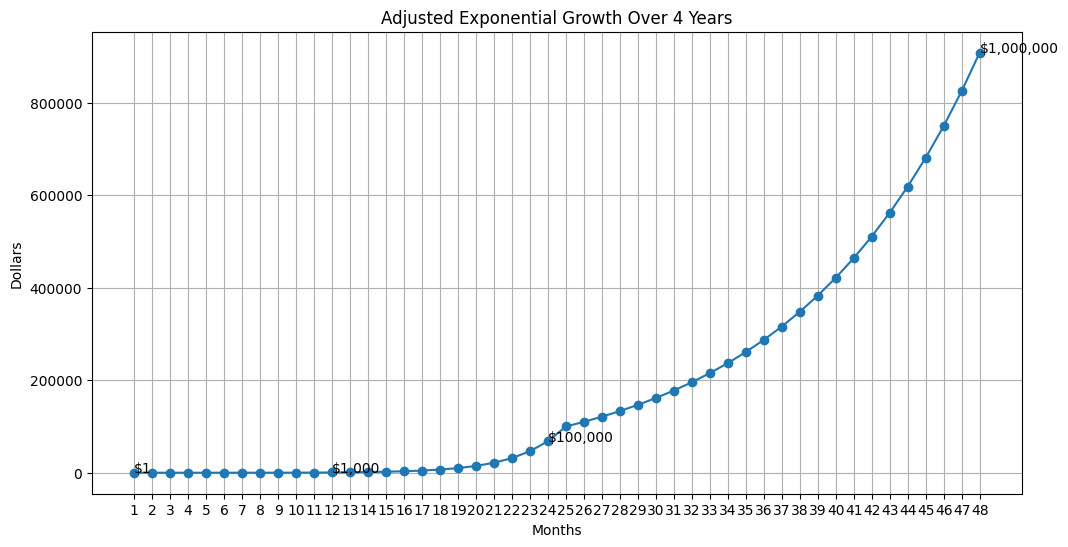
- Pricing Logic. The pricing structure of $USDP is designed to balance accessibility in early stages with accelerated value appreciation as participation increases over time. Phase 1 (Months 1–24): Gradual exponential growth from $1 to approximately $100,000, encouraging early participation and accumulation at lower price levels. Phase 2 (Months 25–48): Accelerated growth from approximately $100,000 to $1,000,000, reflecting increased participation and demand as the platform matures. The pricing curve is enforced programmatically using a time-based oracle that reads block timestamps to determine the current price. Both buy and sell prices are set at the scheduled price at any given moment. Tokens are non-transferable outside the DEX through custom ERC-20 contract restrictions, ensuring all trading occurs in this controlled environment. Sellers realize a profit only when they sell their token; the rising schedule is intended to attract participants, however liquidity depends on ongoing demand and is not guaranteed.
- Non-Transferable Tokens. The $USDP token is designed to be non-transferable outside its designated platform environment. Rather than functioning as a freely circulating token across external wallets and exchanges, transfers are restricted through custom token controls so that trading occurs only within the platform’s closed system. This setup is intended to preserve the integrity of the programmed price model, support the platform’s structured trading experience, and prevent unauthorized secondary-market activity that could interfere with scheduled pricing.
- Liquidity and selling mechanism. During the four‑year growth phase, the USD Private platform is open to anyone except users in geo-blocked jurisdictions. Participants maintain self‑custody of their funds and private keys, and all orders settle on‑chain. Users can withdraw their underlying funds (e.g., USDC) at any time. $USDP itself cannot be withdrawn and must remain within the DEX until conversion. Sellers enter a first‑come, first‑served queue to match with buyers; the same queue is used by all participants (including team members) ensuring that no one receives preferential treatment. Users wait in the queue until a buyer and seller are matched.
4 Economic Growth & Potential Benefits
The economic model of $USDP is engineered to create sustained demand and broad social impact:
- Fixed Growth Schedule. $USDP follows an initial multi-phase growth schedule that increases from $1 to $1,000,000 over four years. Instead of being driven by open-market volatility, the token price follows a fixed programmed path within the platform. This is designed to create a more predictable growth structure while supporting a controlled trading environment. The rising schedule is intended to attract early supporters and speculators and encourage continued buyer participation. However, liquidity depends on market participation and is not guaranteed.
- Resilient Demand. By structuring a rising price, USD Private aims to attract speculators seeking upside and everyday users who want predictable appreciation. The hypothesis is that consistent growth could create more buyers than sellers over time. However, demand is not guaranteed; participants should recognize that future buyers are required to realize profits.
- Revenue model. USD Private derives revenue from fees charged when orders are cancelled, the natural time-based spread captured when a buyer executes at a higher scheduled price than the price at the time the sell order was placed, and proceeds from the project’s initial token sales. Because the platform uses self-custody and does not hold user funds or private keys, participants maintain full control of their assets. However, regulatory obligations may still apply; participants should consult their own legal and tax advisors to understand compliance requirements in their jurisdictions.
- Long-term utility through USDM. USDM is intended to extend the value of $USDP beyond its initial growth cycle. By enabling conversion into a privacy-focused blockchain asset, the project aims to give holders access to a more functional long-term ecosystem rather than ending at price appreciation alone. This future utility is designed to support continued relevance, broaden use cases, and provide participants with access to private, low-visibility transactions within a dedicated blockchain environment.
- Uplifting the Underserved. USD Private’s mission includes targeting low‑income individuals who rarely benefit from financial innovation. The platform emphasizes that early adopters in underprivileged communities can see a small investment grow to substantial sums over four years (e.g., ten cents will grow to $100,000) through price appreciation. Access initially focuses on these communities; as the price rises, participation gradually opens to wealthier participants.
5 Tokenomics
- Token Name and Ticker. The token is referred to as $USDP and forms part of the broader USD Private project.
- Supply and Distribution. A total of 1,000,000 $USDP tokens are planned for initial minting at launch on Base. $USDP uses a custom ERC-20 token structure designed for use only within the platform and is permanently non-transferable outside the designated trading environment. The token price follows the platform’s programmed schedule rather than open-market volatility, with pricing supported through a Chainlink oracle and platform logic.
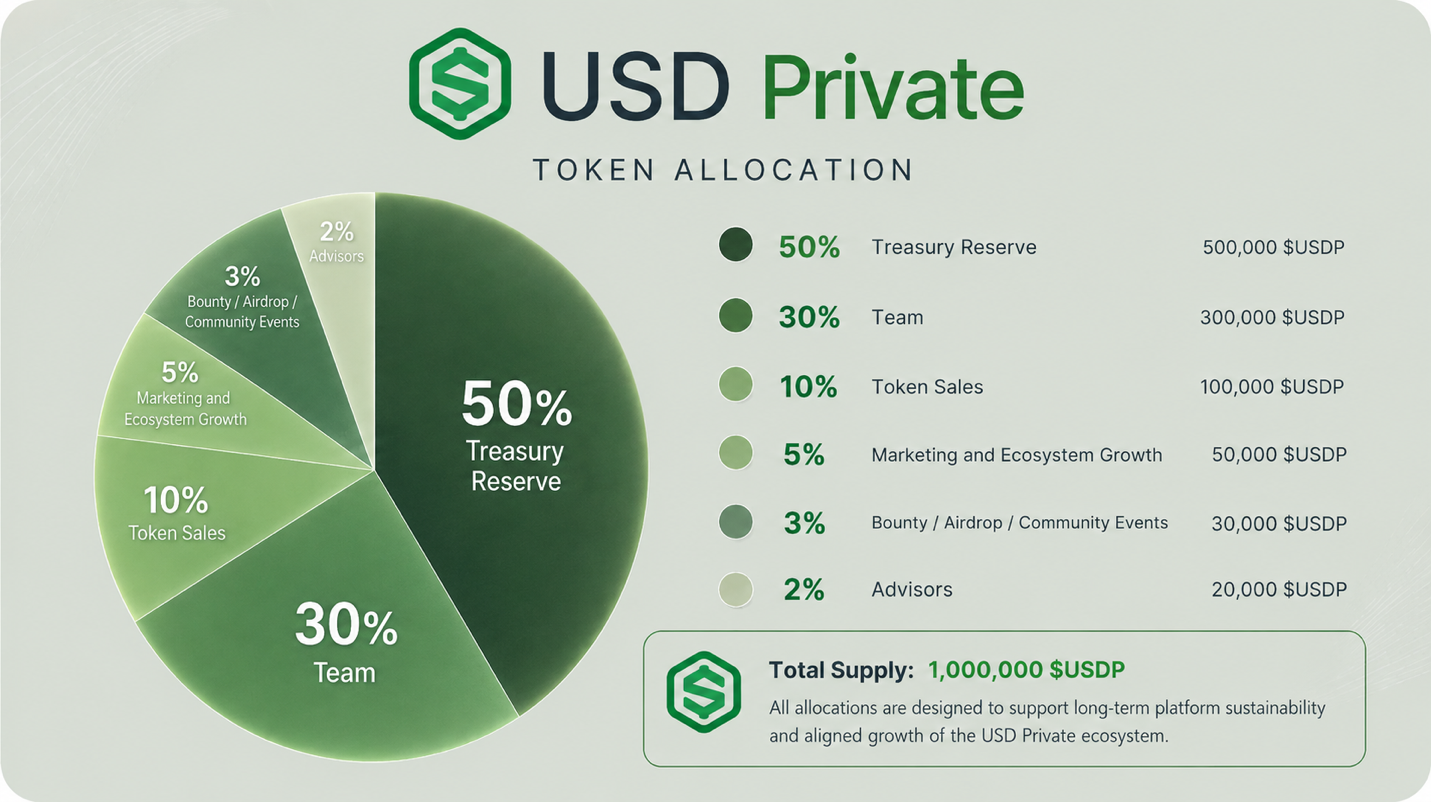
- Token Allocation Breakdown. At launch, the total token supply will be allocated as follows:
- 50% — Treasury Reserve (500,000 tokens)
- 30% — Team (300,000 tokens)
- 10% — Token Sales (100,000 tokens)
- 5% — Marketing and Ecosystem Growth (50,000 tokens)
- 3% — Bounty, Airdrop, and Community Incentives (30,000 tokens)
- 2% — Advisors (20,000 tokens)
This allocation is designed to balance long-term platform sustainability, aligned team incentives, and early-stage growth initiatives.
- Lockup and Vesting
To align incentives and promote long-term commitment:
- Team Allocation (30%). Subject to a 12-month lockup period, during which no tokens may be sold.
- Advisor Allocation (2%). Subject to a 6-month vesting schedule, with tokens released on a monthly linear basis.
All other allocations are distributed in accordance with platform needs, including treasury management, ecosystem development, and user incentives.
- Launch Control of Supply. The initial token supply is held by the BVI issuer entity, which controls distribution at launch. This includes the pre-sale distribution of USD Private team allocations and the release of tokens designated for public sale, treasury, and marketing purposes.
- Governance and control. Tokenomic control remains centralized at launch. USD Private has authority over core tokenomic decisions, including approval of any future minting and any permitted adjustments to the pricing curve. These actions are expected to be carried out through a single founder-controlled wallet. The Panama operating entity is responsible for platform operations and does not control tokenomics.
- Core Token Design Rules. USDP is designed with several core operating rules:
- the token is permanently non-transferable outside the platform
- there is no staking mechanism
- tokens may be burned
- additional $USDP may be minted only with USD Private team approval
- an admin pause function may be used in limited circumstances, including major token events such as minting
- blocklist controls may be applied for restricted jurisdictions
All participants, including the USD Private team and contributors, are subject to the same platform sell process. No participant receives priority in the sell queue, which is intended to operate on a first-in, first-out basis.
6 Security Review & Platform Controls
Security is a core consideration in the design and operation of the USD Private platform. The smart contracts and platform infrastructure completed a full smart contract audit and penetration test by Cyberscope in May 2026. Following remediation and revalidation, the final review confirmed that the identified findings had been resolved.
The security review covered both contract-level and platform-level risks. This included analysis of the core smart contract logic, access controls, transaction flows, and potential vulnerabilities that could affect platform integrity or user interactions. The penetration test also assessed the broader platform environment for common web and infrastructure risks, helping evaluate how the system performs under adversarial conditions.
In addition to third-party testing, the platform is designed around a controlled architecture intended to reduce unnecessary exposure. $USDP operates within a closed trading environment, with token transfer restrictions designed to keep activity within the platform and preserve the integrity of its programmed pricing model. This structured design helps limit unauthorized external trading pathways and supports tighter control over platform behavior.
USD Private’s approach to security is based on layered protection: audited contract logic, tested platform infrastructure, controlled token functionality, and ongoing attention to operational risk. As the platform develops, security reviews, testing, and monitoring are expected to remain an ongoing part of the project’s development process.
7 Roadmap
Year/Quarter | Milestone | Status |
2025–2026 | DEX development, smart‑contract design, time‑based oracle, security audits and penetration testing (Cyberscope – April 2026) | Completed |
Q1 2026 | Marketing and public relations partnerships | Secured / In progress |
Q2 2026 | Platform launch and commencement of token sales on the DEX | Planned |
2027–2028 | Expand community outreach; iterate DEX features and evaluate demand; testnet for USDM conversion | Planned |
2029 | Launch USDM and the new privacy‑focused Layer‑1 chain; allow 1:1M conversion from USDP | Planned |
8 Partners
USD Private currently works with a limited number of confirmed external partners supporting key functions of the project.
- Cyberscope - served as the project’s independent smart contract auditor and cybersecurity review partner. Its role included auditing the token contract and conducting penetration testing on the platform environment to identify security vulnerabilities and technical risks prior to launch. The final audit was completed in May 2026, and identified findings were addressed. This work supports the project’s focus on platform security and technical readiness.
9 Team & Core contributors
- Independent Director (Non-Executive Oversight) - Phillip Nelson - Serving as the independent director of the Company, Nelson provides independent oversight, strategic guidance, and governance review in support of the project’s objectives. He is not involved in day-to-day operations, and brings experience in corporate governance, international structuring, and regulatory considerations.
- Core Development Team - Cytric is the external blockchain development firm engaged to support the build and technical implementation of the USDP platform. Its role includes smart contract development, platform architecture, and related engineering support for launch and ongoing product development.
10 Risks & Considerations
Participation in USDP involves significant risks and prospective participants should carefully consider the following before engaging.
- Liquidity Risk. The structured-growth model depends entirely on continuous buyer participation for liquidity. If insufficient buyers materialize at higher scheduled price levels, sellers may face extended queue delays or be unable to exit at all. Although the price is programmed to rise predictably, there is no guarantee of available liquidity at any given time.
- Technology Risk. Smart contracts and the platform have undergone a full audit, but vulnerabilities may still exist in any blockchain protocol. Users should exercise caution, conduct their own security review, and only interact with amounts they can afford to lose.
- Regulatory Risk. Operating through a BVI entity and geo-blocking certain jurisdictions does not eliminate regulatory uncertainty—laws may change, and participants should consult legal and tax advisors regarding compliance. U.S. persons are blocked, and additional jurisdictions may be restricted without notice.
- Central Control Risk. USD Private’s ability to modify the pricing curve centralizes control; while changes are intended to be transparent, they could impact returns.
- Long-term Utility Risk. The planned conversion to USDM — the first private and anonymous USD blockchain — is a future utility only. There is no guarantee that the new chain will launch as planned or achieve its intended privacy and utility features once live and subject to market forces.
11 Conclusion
$USDP reimagines what a digital dollar can be: a structured‑growth currency that offers programmed price appreciation for early supporters followed by the first private and anonymous USD blockchain. The combination of a rising‑price model and a closed exchange aims to address the problem of price volatility by ensuring that token value increases predictably. The roadmap is designed to introduce additional utility that may support long-term demand for the token through a privacy‑focused USD chain. Central to the project is a mission to empower low‑income individuals and encourage socially positive behavior. Prospective participants should weigh the risks and uncertainties described above against the potential benefits of a novel digital asset model and consult independent advisors before participating.